First-birthday lighting: baby portraits, doljanchi and doljabi scenes
Compare soft studio, window and bright celebration light for first-birthday portraits. Keep the baby’s face readable alongside the table and selected props.
Start with the baby’s face rather than the decorations. The new comparison depicts the same fictional baby in three AI-created moods. Use these placements as starting points, with supported poses appropriate to the actual child and no assumption of nationality or developmental ability.
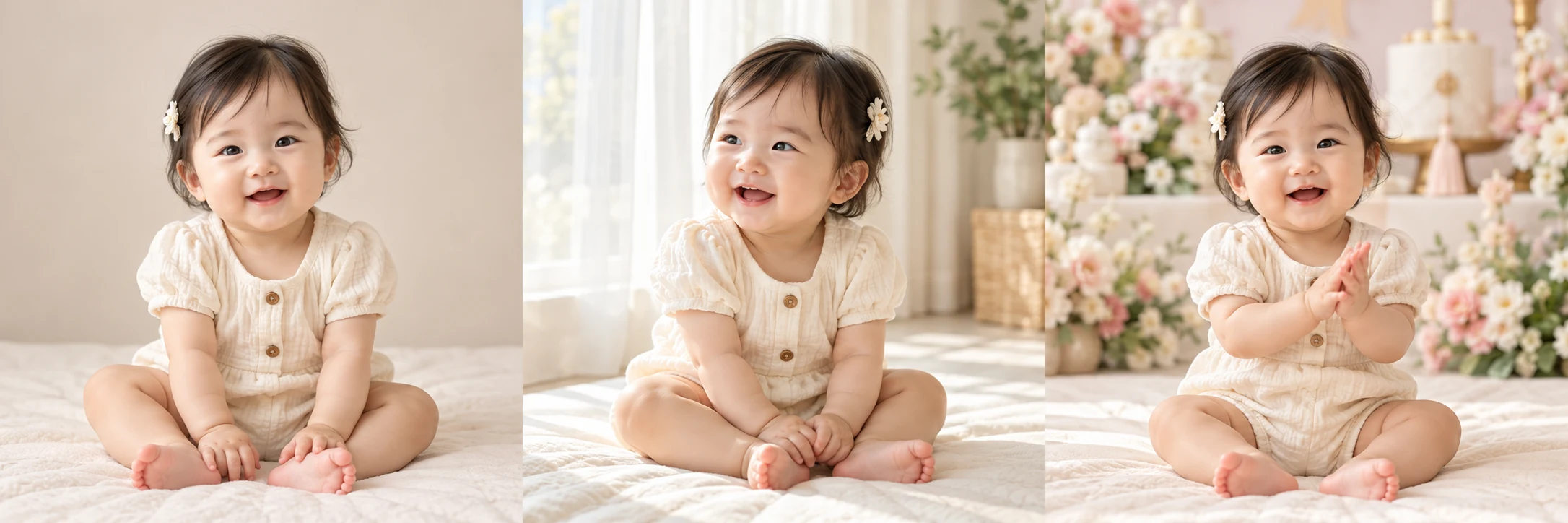
- Soft baby-centered portrait
- Natural window portrait
- Bright first-birthday celebration
Which light suits which situation?
Placements and angles are editorial starting points informed by lighting principles, not fixed rules. Adjust source size, distance and position for the space and subject. The mood examples do not reveal measured equipment settings or exact output.
Soft baby-centered portrait
When to use it: For a clear, composed record of the baby’s expression.
Intended mood: Gentle cheek transitions and natural skin create a settled impression.
- Key position
- Place a broad diffused key near the camera axis, about 0–30 degrees to one side and slightly above eye level.
- Fill and grouping
- Use a white reflector opposite the key or below the face to gently lift under-eye and chin shadows.
- Distance and backdrop
- Keep a simple backdrop separate from the subject and visually quieter than the face.
- What to inspect
- Adjust exposure after checking both eyes and skin detail. Increasing output alone does not make a source softer.
Context-specific adjustment: Position the light for the baby’s actual eye height, not an adult sitter.
Natural window portrait
When to use it: For a relaxed home or daylight-studio growth record.
Intended mood: Soft side light and a familiar setting feel warm and intimate.
- Key position
- Use a broad window about 45 degrees to the side, avoiding direct sun on the face; diffuse it with a sheer curtain when needed.
- Fill and grouping
- Use a white wall or reflector opposite the window to retain detail in the darker cheek.
- Distance and backdrop
- Check whether warm room lights and daylight create different colors on either side of the face.
- What to inspect
- Compare face direction and distance from the window, then rebalance exposure rather than assuming every window produces the same light.
Context-specific adjustment: Base head and body support on the actual child’s development and reference pose.
Bright first-birthday celebration
When to use it: For a requested dol table and large celebration props.
Intended mood: A luminous pastel scene keeps the baby’s face natural and clear.
- Key position
- Use a large diffused key near the front at about 20–30 degrees to keep expressions and clothing readable.
- Fill and grouping
- Lift deep under-eye shadows with a reflector or broad subtle fill.
- Distance and backdrop
- Light a pale backdrop separately while preserving detail in white clothes and skin.
- What to inspect
- Watch for colored decorations spilling onto faces. Balance the subject and backdrop separately instead of simply increasing the key.
Context-specific adjustment: Check colored bounce and white-clothing detail; avoid loose small or hazardous props.
What to check in the result
- Check eyes and cheek shadows first
- Keep decoration colors from strongly tinting skin
- Preserve real identity and development-appropriate posing
Lighting questions for this portrait
What is a useful starting light for a first-birthday portrait?
Try a broad diffused key near the front and gentle bounce that leaves eyes and cheeks readable. Judge the apparent source size and actual shadows rather than equipment names alone.
Should lighting change for doljabi props?
Check that the selected book, brush or microphone remains visible without obscuring the face. Balance the subject and backdrop separately so decorations do not become brighter at the baby’s expense.
Were these examples actually photographed with these setups?
No. They are AI-created mood illustrations and the placements are editorial proposals. They are not measured comparisons of output, color or shadows, or documentary photo sessions of the same person.
Does choosing light in Memory Photo automatically generate an image?
Memory Photo prepares a prompt. You attach the prompt and original photographs directly to an external AI and inspect identity, subject or pet count and the actual lighting expression in the result.
Apply it in Memory Photo
Choose the photo category and subtype, then the location, light and pose. Describe the desired light direction and mood in additional direction. Attach the completed prompt and source photographs directly to your selected AI conversation.
Open the photo studio ↗