Memorial-portrait lighting: dignified faces, warm remembrance and restoration
Compare restrained frontal light, warm remembrance portraits and monochrome tone. Archival restoration preserves the source lighting instead of inventing a new session.
A formal memorial portrait prioritizes one frontal subject and readable eyes. A remembrance composition may use gentle warmth or monochrome. Faithful archival restoration is a different task: do not arbitrarily change the source pose, clothes, background or light direction. The examples depict a fictional model, not an actual deceased person.
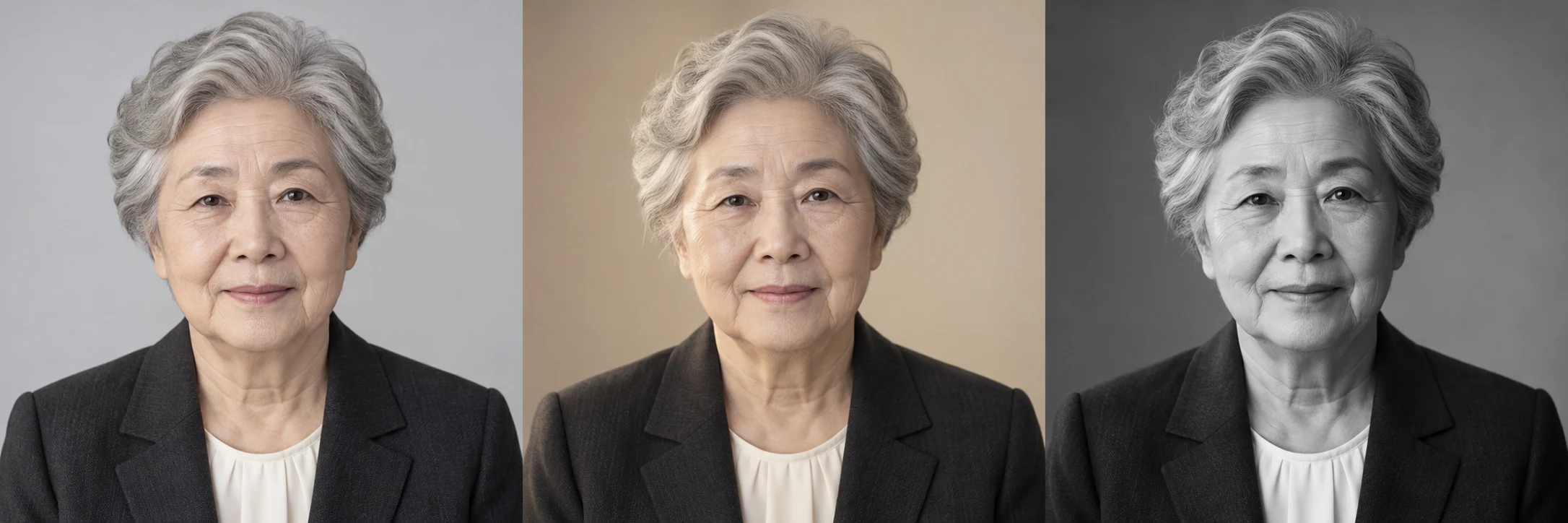
- Formal memorial: frontal soft light
- Remembrance: warm soft light
- Monochrome remembrance: restrained tone
Which light suits which situation?
Placements and angles are editorial starting points informed by lighting principles, not fixed rules. Adjust source size, distance and position for the space and subject. The mood examples do not reveal measured equipment settings or exact output.
Formal memorial: frontal soft light
When to use it: For a dignified frontal portrait used in remembrance.
Intended mood: A clear, calm single-subject face with both eyes readable.
- Key position
- Place a broad diffused key near the camera axis, about 0–30 degrees to one side and slightly above eye level.
- Fill and grouping
- Use a white reflector opposite the key or below the face to gently lift under-eye and chin shadows.
- Distance and backdrop
- Keep a simple backdrop separate from the subject and visually quieter than the face.
- What to inspect
- Adjust exposure after checking both eyes and skin detail. Increasing output alone does not make a source softer.
Context-specific adjustment: Keep frontal head and gaze; do not add dramatic rims, props or religious symbols without instruction.
Remembrance: warm soft light
When to use it: For an explicitly requested new commemorative treatment.
Intended mood: Gentle side light and a warm neutral backdrop feel tender and composed.
- Key position
- Use a broad window about 45 degrees to the side, avoiding direct sun on the face; diffuse it with a sheer curtain when needed.
- Fill and grouping
- Use a white wall or reflector opposite the window to retain detail in the darker cheek.
- Distance and backdrop
- Check whether warm room lights and daylight create different colors on either side of the face.
- What to inspect
- Compare face direction and distance from the window, then rebalance exposure rather than assuming every window produces the same light.
Context-specific adjustment: Honor source-clothing and backdrop preservation choices; do not generate a physical frame or glass.
Monochrome remembrance: restrained tone
When to use it: For a user-requested monochrome portrait.
Intended mood: Expression and gradual tonal differences take priority over color.
- Key position
- Place a broad diffused key about 30–45 degrees to the side for gradual facial tonal transitions.
- Fill and grouping
- Use gentle fill to retain both eyes and real age characteristics, without flattening texture or de-aging.
- Distance and backdrop
- In monochrome, separate hair, clothes and background by tone rather than relying on their colors.
- What to inspect
- Choose monochrome only as an explicit commemorative treatment. It is not permission to change the tones of an archival restoration.
Context-specific adjustment: Distinguish this creative treatment from source-faithful restoration and preserve age characteristics.
What to check in the result
- Check one frontal subject and portrait orientation
- Preserve actual age and identity
- Separate faithful restoration from recomposition
Lighting questions for this portrait
Should formal memorial portraits use dramatic Rembrandt shadows?
Prioritize restrained light that keeps the frontal face and both eyes readable rather than theatrical contrast. Preserve the subject’s real age and recognizable features.
Should an old photograph be relit during restoration?
Faithful restoration does not restage lighting, background or expression. Correct observable damage, tone and clarity within the chosen policy; separate it from explicitly requested recomposition.
Were these examples actually photographed with these setups?
No. They are AI-created mood illustrations and the placements are editorial proposals. They are not measured comparisons of output, color or shadows, or documentary photo sessions of the same person.
Does choosing light in Memory Photo automatically generate an image?
Memory Photo prepares a prompt. You attach the prompt and original photographs directly to an external AI and inspect identity, subject or pet count and the actual lighting expression in the result.
Apply it in Memory Photo
Choose the photo category and subtype, then the location, light and pose. Describe the desired light direction and mood in additional direction. Attach the completed prompt and source photographs directly to your selected AI conversation.
Open the photo studio ↗